Key Takeaways
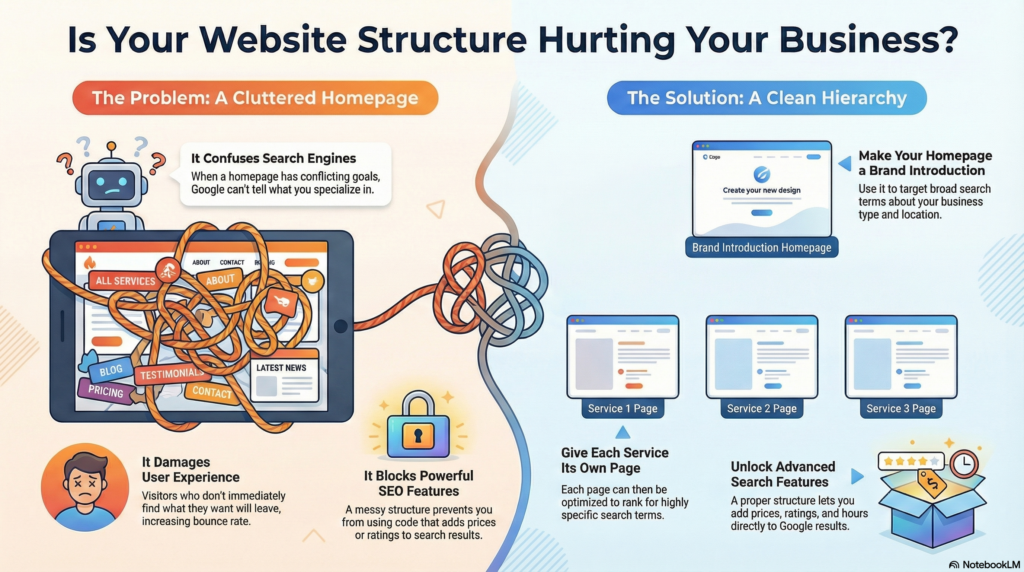
- • Your homepage shouldn’t try to be two things at once – using it as both your brand introduction and your main sales page confuses search engines and visitors
- • Each service needs its own page – even if one service is your main revenue driver, giving it a dedicated page actually strengthens its visibility
- • Clean hierarchy unlocks better search features – proper structure lets you use schema markup (code that helps search engines understand your business) to show prices, ratings, and details directly in search results
- • Search engines struggle with cluttered homepages – when everything lives on one page, Google can’t tell what you actually specialize in
Website structure is how your pages are organized and connected to each other. Think of it like a family tree – your homepage is the parent, and your service pages, about page, and contact page are the children. Each page should have a clear purpose and a logical place in that hierarchy.
Does my website structure actually matter if I have all the right information?
Yes, and here’s why. You can have perfect content, but if it’s organized wrong, you’re working against yourself. Most small business owners build websites by dumping all their information on the homepage and then creating a few extra pages for overflow details. This seems logical – get everything in front of visitors immediately. But this approach hurts your online visibility in ways you probably don’t realize.
Search engines like Google expect websites to follow a certain logic. The homepage represents your brand and location. Individual pages represent specific services or products. When your homepage tries to be both the brand face and the main product page, Google gets confused about what you actually do.
Here’s a real example. A surf school in Maui offers two types of lessons: board surfing and canoe surfing. Board lessons are their main business. Their homepage is entirely dedicated to selling board surf lessons, with just one separate page for canoe lessons. On paper, they’re providing all the information. In practice, they’re creating three problems that damage their online presence.
What happens when my website hierarchy is broken?
Using that surf school example, here are the specific issues:
The homepage tries to accomplish two conflicting goals. It needs to tell Google “we’re a surf school in Maui” while also saying “book board surf lessons here.” This dilutes the page’s focus. Someone searching for “Maui surf school” or “water sports Maui” won’t find them easily because the homepage is hyper-focused on one specific lesson type.
The user experience suffers too. If someone lands on the homepage looking for canoe surfing but sees a page 100% dedicated to board surfing, they’ll assume they’re in the wrong place and leave. Your bounce rate goes up, and that signals to search engines that your site isn’t relevant.
The site hierarchy becomes nonexistent. The homepage acts as both a parent page and a service page. The canoe lesson page hangs awkwardly in the structure with no clear relationship to anything. There’s no logical flow that makes sense to visitors or search engines.
Even if you only offer one service, this same principle applies. Your homepage should introduce your business, and your service should have its own dedicated page where you can fully optimize for the specific searches people use to find that service.
How does fixing the structure help my business?
A clean hierarchy solves these problems and creates new opportunities. When you give each service its own dedicated page, you can optimize each one specifically with its own URL, title, and focused content. Your homepage becomes what it should be – an introduction to your business that targets broader search terms.
Schema markup becomes usable. This is code that tells search engines structured information about your business. With proper hierarchy, you can mark your homepage as a business location (showing your address and hours) and mark each service page as a product (showing prices and availability). This information can appear directly in search results, making your listing stand out from competitors.
Each page can rank independently. Instead of one overloaded homepage competing for every keyword, you now have multiple pages that can each rank for specific searches. You’ve just multiplied your opportunities to be found online.
The Bottom Line
Your website structure is part of your online presence management strategy, not just a design choice. Clean hierarchy helps search engines understand what you offer, helps visitors find what they need, and unlocks technical features that make you more visible in search results. The fix isn’t complicated – give each main service its own page, let your homepage be an introduction to your business, and organize information in a way that makes logical sense.
Small structural changes create measurable improvements in online visibility. You’re not changing what you offer or how good your services are. You’re just organizing information in a way that works with how search engines and people actually find businesses online.