Key Takeaways
- • Cover the basics first – Google Business Profile, a simple website, and active social media. Without these, scaling efforts won’t work.
- • Keywords research isn’t fancy – it’s just figuring out what people type when searching for businesses like yours.
- • Scaling means creating valuable content that answers real customer questions, not showcasing expertise only other professionals understand.
- • AI can help with some tasks (finding local directories, optimizing profiles) but fails at keywords research.
- • Building online visibility takes time – start with foundations, fine-tune, then scale.
Why aren’t customers finding you online?
You’re open daily, but the phone stays silent. The neighboring business seems busy while you wait for customers. You search for your business on Google and find yourself on page three – if you find yourself at all. This usually means your digital foundation is missing or incomplete.
Step 1: Cover the Basics
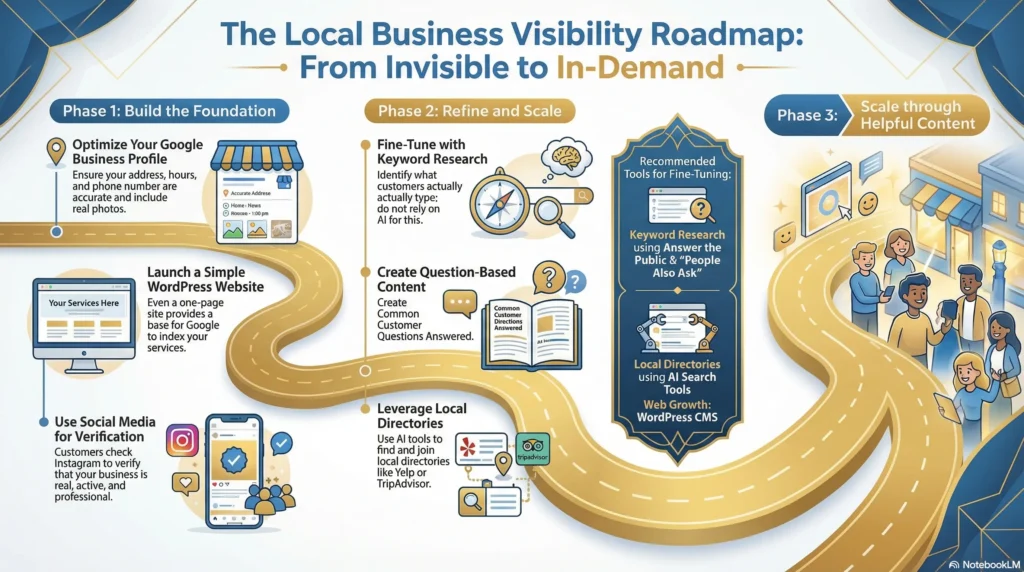
Start with your Google Business Profile. At minimum, update your information and add a few real photos. You can use AI tools to optimize your profile descriptions, but the core information – hours, address, phone number – needs to be accurate.
If you’re a service business, you need a website. Even a one-page site gives you a base that Google can index. WordPress works best if you plan to grow.
Social media matters more than you think. When people find you through Google Maps or your website, they often check your Instagram to verify you’re real and active. For restaurants, Instagram shows your interior and food. For service businesses, people navigate to your website to check service offerings and pricing.
Pro tips: Build your website on WordPress if you’re looking to grow. Restaurants – people use Instagram to check your interior and food. Service businesses – people check your website for service offerings and pricing.
Step 2: Fine-Tune with Keywords
Now that you have the basics covered, the best thing you can do before scaling is fine-tuning. This means doing keywords research and optimizing your existing content using those keywords.
Keywords research is just figuring out what people type into search when looking for businesses like yours. Once you know those phrases, use them everywhere – your website, your Google profile, your Instagram. This tells Google your business is relevant for those searches.
Look at what your competitors rank for. Check “People Also Ask” sections on Google. Use tools like Answer the Public to see actual questions people type. Then integrate those phrases naturally.
A warning: AI models perform poorly at keywords research. They invent search phrases that don’t exist. Do your own homework here.
Step 3: Scale Your Content
By this time you have a basic website, an optimized Google Business Profile, and a live Instagram. Algorithms understand you exist and what you offer.
Now scale and show algorithms you’re an expert with exactly what people are looking for.
The foundational truth is simple: create valuable content. Write articles, record videos, publish consistently.
Valuable content helps people find answers or solve problems. Content where you explain technical things only other professionals understand is usually useless for your customers. If they can’t understand it, it doesn’t help.
Pro Strategies to Scale Your Content:
- Website hierarchy matters more than you think. I put together a resource explaining how to fix it here.
- Keywords research sounds complicated but it’s actually simple. Here are some tricks I recommend applying.
- Answer the Public is one of the best free tools to see what people actually type into search
- You don’t need to be a professional writer to create content that works. I wrote about this here.
- Don’t forget local directories like Yelp and TripAdvisor. This is where AI actually helps – it can research directories specific to your location and save you hours.
Summary
Improving your business visibility online starts with the basics: an updated Google Business Profile, a simple website, and active social media. Fine-tune with keywords research to match how people search. Then scale by creating content that answers real customer questions. Skip the shortcuts and focus on being consistently present and helpful online.